
State of React Native 2024: Our Key Takeaways
 Karolina Kulig•Mar 3, 2025•6 min read
The React Native ecosystem is growing fast, and the 2024 State of React Native survey shows us where things are heading. Let’s have a quick look at the latest trends!
The Rise of Universal Apps
See: State of React Native > Target platforms
The trend toward universal apps is gaining momentum, and React Native is at the forefront of this movement. Expo Router is a key player in this shift, offering a powerful and intuitive file-based routing system that simplifies universal app development. The State of React Native 2024 survey shows that Expo Router is gaining significant traction among developers, with high awareness and growing usage. While some developers report issues with Expo Router’s documentation, particularly around configuration, it’s clear that this tool is a major force in the movement towards universal apps.
Seeing more and more libraries written with web in mind (Reanimated 4 being one example) also backs our feeling that we’re shifting towards universal apps. Another interesting trend is the rise of web-inspired styling solutions, particularly NativeWind, which has seen a significant increase in usage, with 20% of developers now adopting it. This demonstrates the growing influence of web development practices on mobile styling.
Reanimated: the default for React Native animations
See: State of React Native > Graphics and Animations
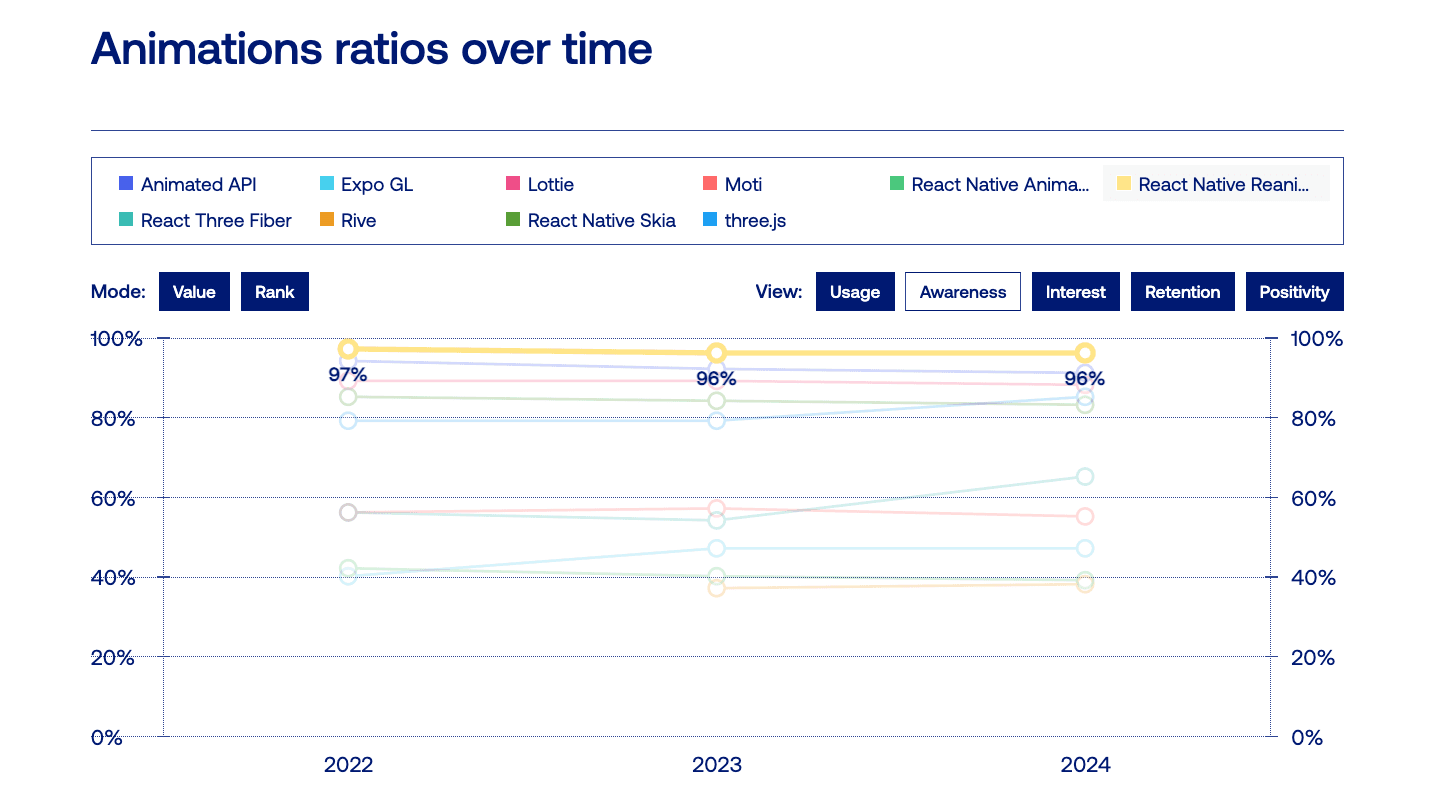
As Reanimated creators, we can proudly say that Reanimated became the go-to library for smooth and engaging animations. With 80% of developers aware of Reanimated and 70% expressing a keen interest, it’s clear that this library is capturing the attention of the community.
This surge in popularity is driven by Reanimated’s ability to deliver smoother and more performant animations compared to the older Animated API. Developers are finding it easier to use and more effective for creating a wide range of animations, from simple transitions to complex interactions. The high satisfaction rate of 90% confirms that Reanimated is living up to its promise of a better animation experience.
Thank you for your trust!
Local-First: A Growing Trend
See: State of React Native > Local-first App Architecture
The React Native community is clearly embracing the concept of local-first architecture, with a striking 94% of developers expressing interest. This enthusiasm is understandable, given the potential benefits of local-first development; however, despite the high level of awareness and interest, the actual adoption of local-first architecture remains relatively low, with only 25% of developers reporting its use in their projects.
This discrepancy suggests that there may be a lack of user-friendly solutions that facilitate the implementation of local-first architecture in React Native projects.
Debugging: Console Logging Still Rules
See: State of React Native > Debugging and Profiling
SORN 2024 shows that a whopping 70% of React Native developers still rely on console logging as their primary debugging tool. This tried-and-true method continues to be a favorite for its simplicity and effectiveness in identifying and resolving issues.
But here’s the interesting part: despite the continued popularity of console logging, debugging itself has dropped in the rankings of major pain points for React Native developers. This suggests that either developers are becoming more comfortable with the debugging process or other challenges have taken center stage.
Whatever the reason, it’s encouraging to see that debugging is becoming less of a headache for React Native developers. This could be attributed to improved tools, better documentation, or simply a growing familiarity with the React Native ecosystem. Whatever the cause, it’s a positive sign for the overall developer experience.
Also, let us remind you about the fact that we’re also actively trying to improve your experience with our IDE for React Native: Radon.
Expo takes the lead
See: State of React Native > Dev tools experience & sentiment
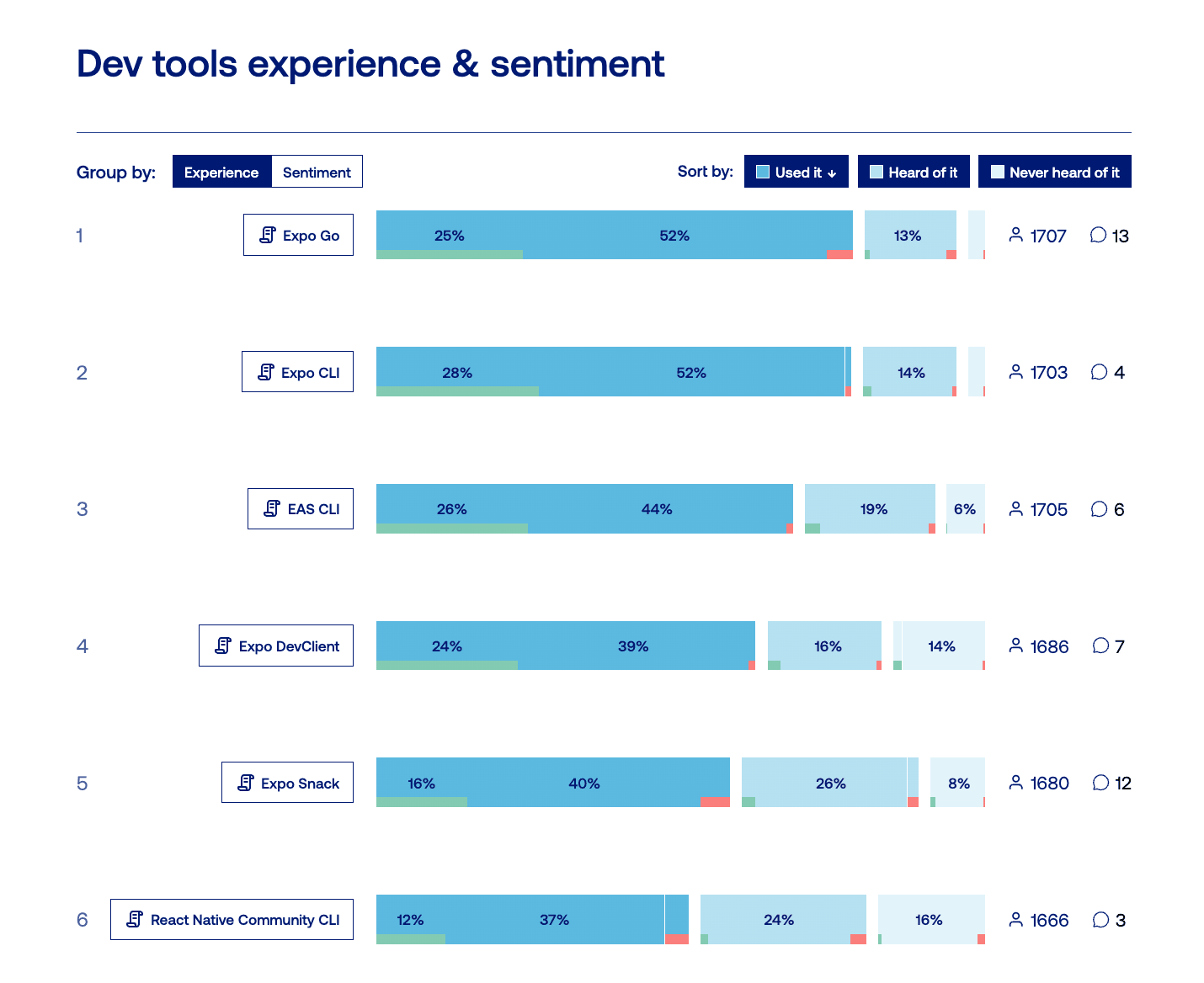
EAS Build has officially become the most popular build tool for React Native developers. The State of React Native 2024 tells us that 50% of you are using EAS Build, leaving Android Studio (40%) and manual builds (30%) in the dust.
You can see Expo’s clear domination in the dev tools section as well. Remember when Meta recommended Expo as the go-to for building React Native apps? Well, it seems like everyone listened. The results show that Expo is now the leading choice for React Native development, with a solid 60% of developers using it in their projects. This is a significant jump from the 40% reported in the 2023 survey, highlighting Expo’s growing popularity.
Expo’s comprehensive suite of tools and services makes it easy for developers to get started, build, and deploy their React Native applications. This streamlined workflow and focus on developer experience have clearly resonated with the community, solidifying Expo’s position as a dominant force in the React Native ecosystem.
Biggest Pain Points
See: State of React Native > React Native pain points
While React Native has a lot going for it, there are still a few areas where developers face challenges. The 2024 edition of the State of React Native highlighted a couple of these pain points.
It seems like wrestling with unmaintained packages is a common struggle for React Native developers. 40% of respondents reported encountering problems with packages that are no longer actively supported. This can lead to compatibility issues, security vulnerabilities, and a general headache when trying to maintain and update projects.
Another pain point for developers is keyboard handling. 20% of respondents reported having issues with keyboard behavior and how it interacts with UI elements. Thankfully, there are community-driven solutions, like the react-native-keyboard-controller package by Margelo and Kiryl Ziusko that can help alleviate some of these issues.
On a more positive note, migrating to the new React Native architecture doesn’t seem to be a major source of pain for developers. Only 5% of respondents reported issues with the transition. This suggests that the migration process is relatively smooth or that developers are not yet prioritizing the switch. Either way, it’s good news for those looking to adopt the new architecture.
Thumbs Up for React Native
It seems like the React Native community is feeling pretty good about the future! According to the 2024 survey results, a solid 75% of developers believe React Native is moving in the right direction. With all the cool new updates and an active community driving things forward, it’s no surprise that 80% of developers are stoked about what’s coming next for React Native. This positive vibe is a great sign that the React Native ecosystem is strong and here to stay.
It’s worth noting that this positive outlook is likely influenced by a bunch of factors, like the new React Native architecture, the growing popularity of Expo, and the fact that more and more companies are using React Native. This positive energy not only attracts new developers and companies to the framework but also motivates current developers to keep contributing and making React Native even better.